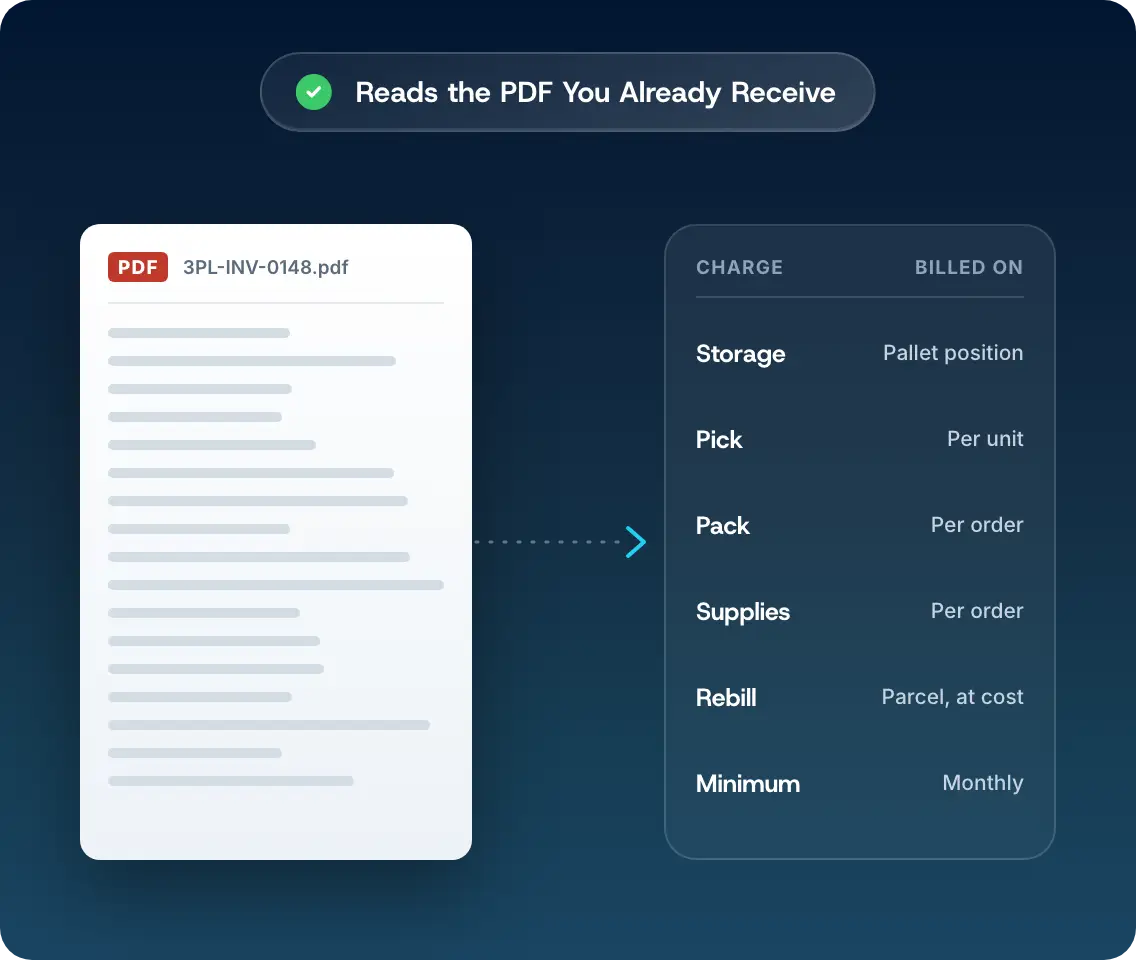





FreightOptics gives finance and supply chain teams software to extract 3PL invoice line items and check each charge against your rate agreement.
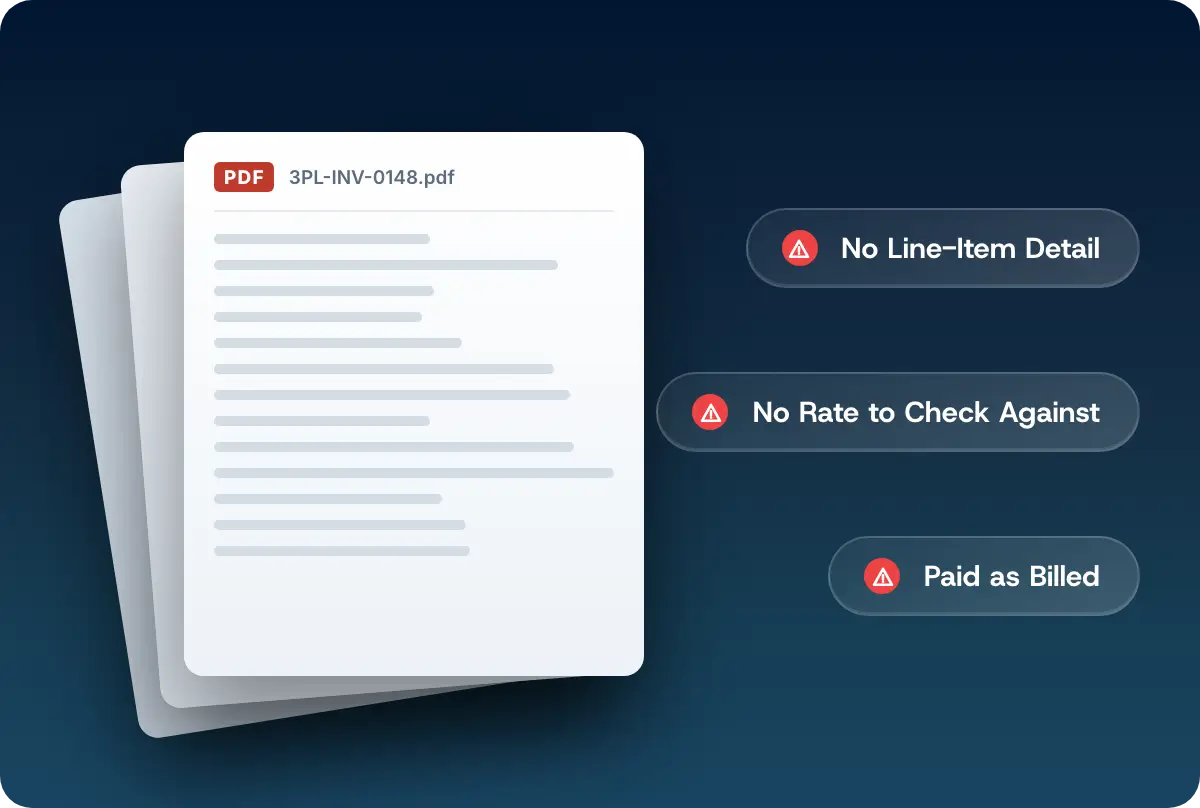
3PL invoices often arrive as long PDF documents with limited line-item detail. Teams pay them without a practical way to check each charge against the agreement.

Without structured line items, finance cannot see what it pays per location, compare charges across warehouses, or forecast cost.

Overbilled storage, incorrect minimums, and marked-up parcel rebills inflate the invoice and go unnoticed.

Auditing a PDF invoice by hand is slow, so teams skip it.
Turn PDF warehouse invoices into structured line items for pick, pack, storage, supplies, rebills, and minimums.

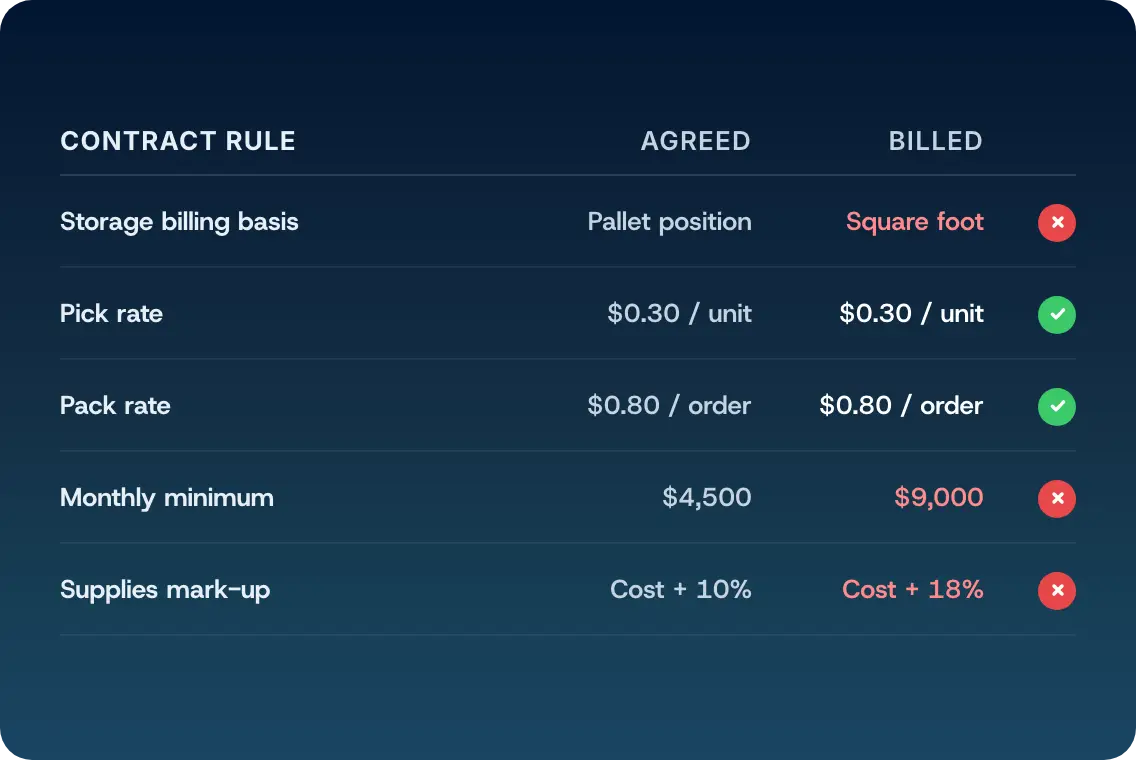
Spot storage, handling, and minimum fees that do not match your agreement.

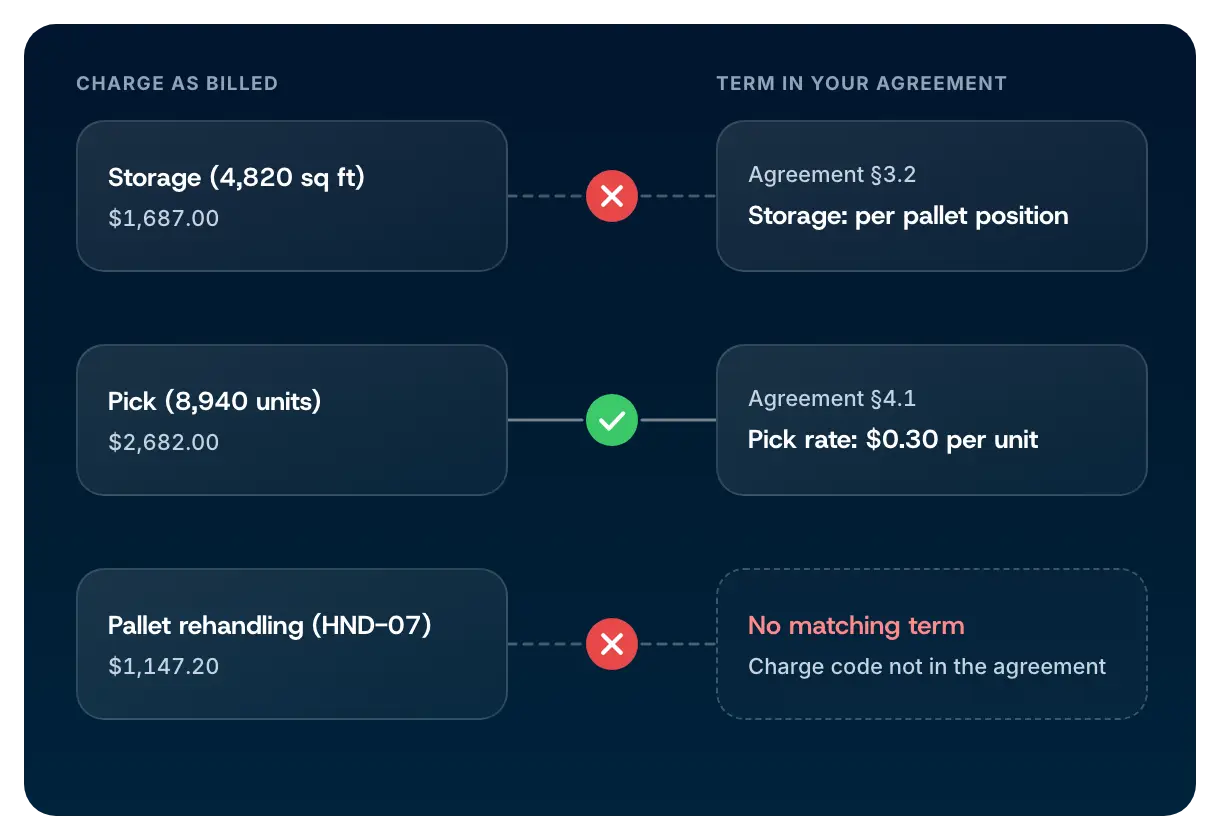
When a charge code appears that your rate agreement never authorized, FreightOptics flags it for review.
Every extracted charge, its rate-agreement basis, and its flag status sit in one record finance and supply chain review together.
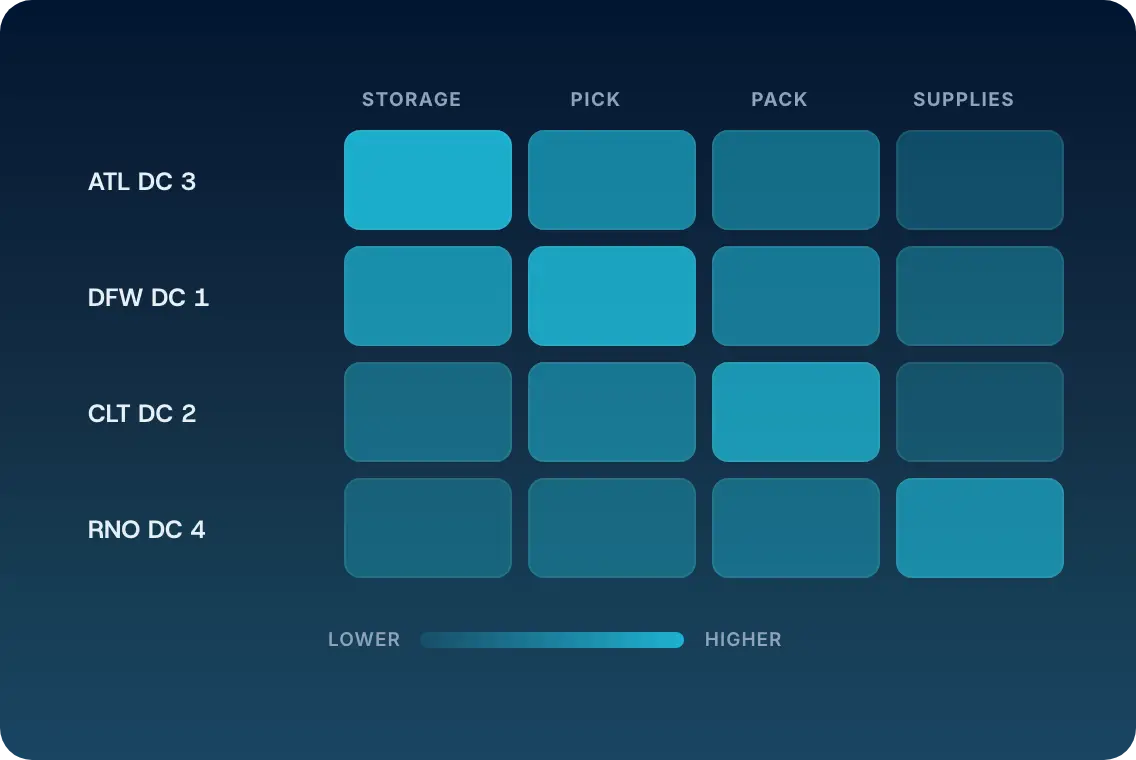
FreightOptics organizes extracted charges by location and charge type, so finance can compare storage, pick, and pack costs across every 3PL site.

With every charge measured against your rate agreement, your team can raise flagged charges and back each one with the invoice line and the contract term.
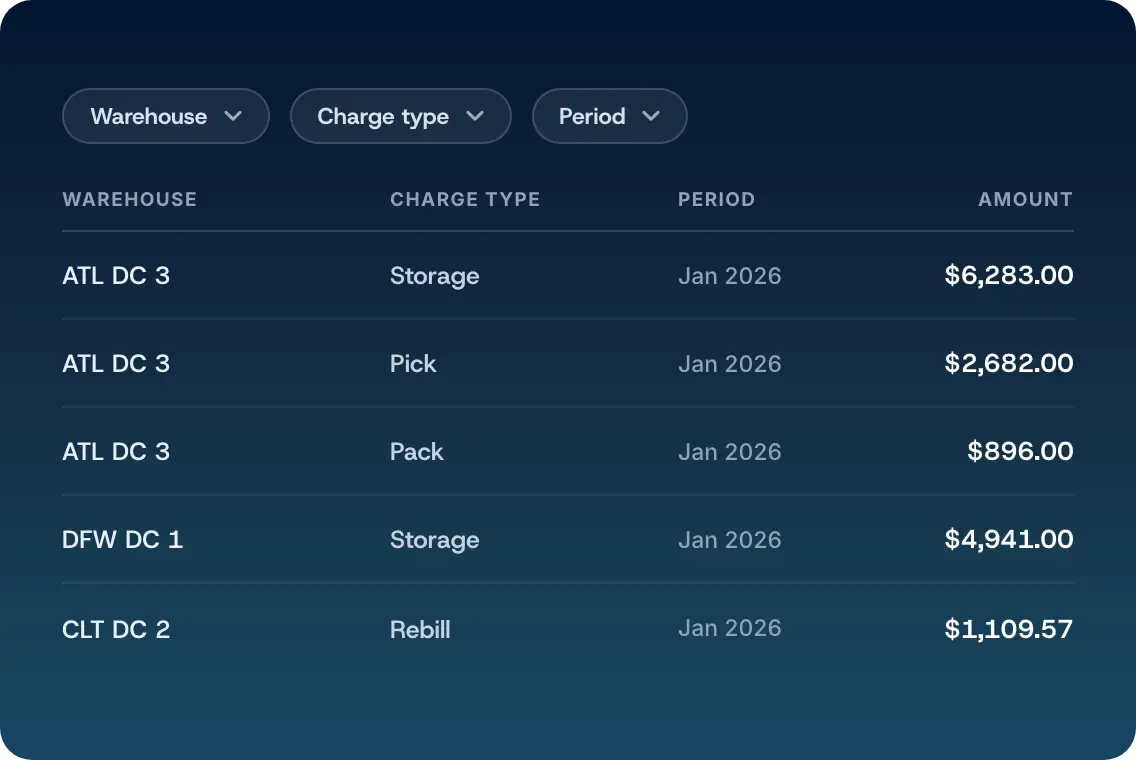
Structured line items replace the PDF, so finance works from itemized figures, not a rekeyed document.
FreightOptics uses AI to read the 3PL invoice and your rate agreement, matching each charge to its contracted rate so finance and supply chain teams review the flags in one place.
FreightOptics reads the PDF invoice your 3PL sends and separates it into individual charges, each tied to its warehouse, date, and charge code.
FreightOptics checks each charge against the rate and term in your agreement, so a storage rate, minimum, or rebill that does not match is flagged.
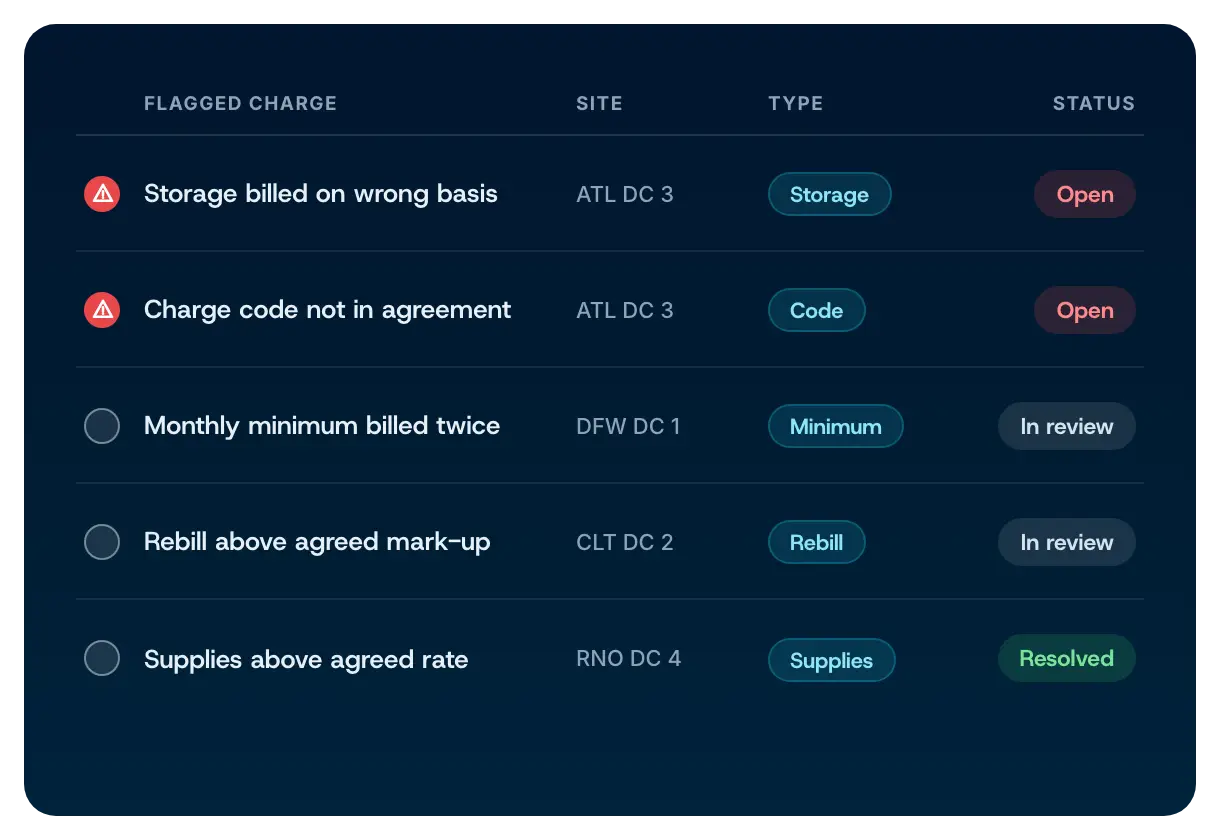
FreightOptics groups flagged charges by type, so your team works a queue of storage, minimum, rebill, and unauthorized-code exceptions instead of rereading the invoice.
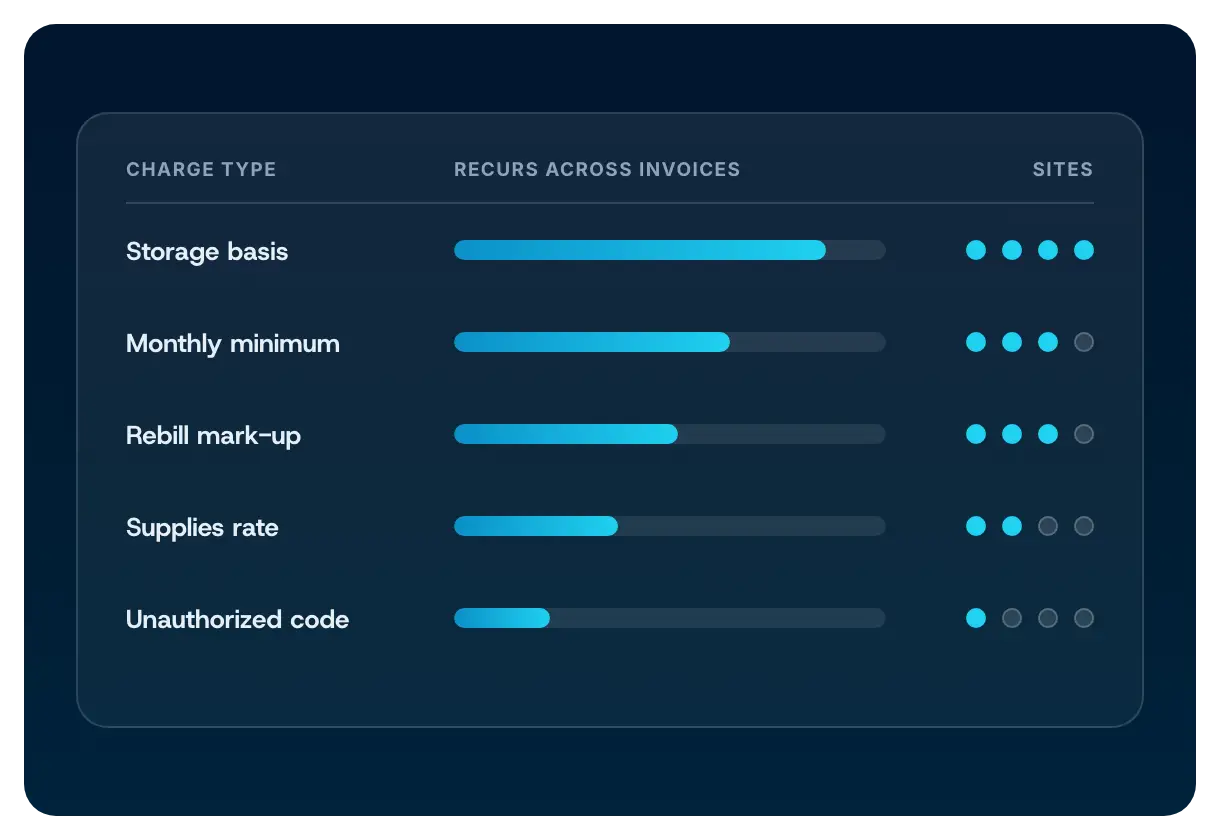
Dashboards show recurring charge patterns across invoices, warehouses, and billing periods, so your team can see which charge types repeat.
FreightOptics organizes 3PL billing in one place so finance can review warehouse charges without a new data feed or changes to warehouse systems.
FreightOptics separates storage, handling, and fulfillment charges into structured line items for review against the rate agreement.
Extracted line items sit in a searchable record your team filters by warehouse, charge type, or period.
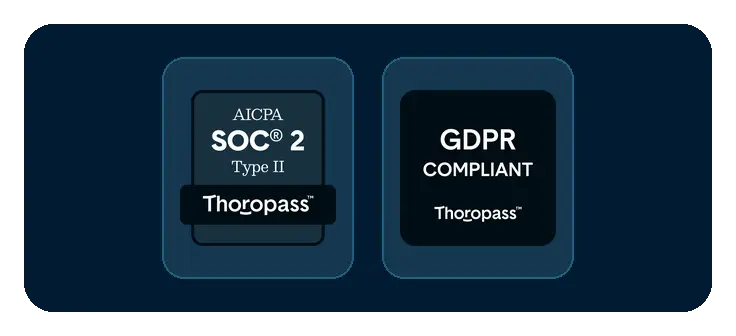
Your invoice data is protected on a SOC 2 Type II certified, GDPR compliant platform.

FreightOptics takes the rate agreement you signed with your 3PL, so every charge on an invoice has a contract to be measured against.

Add the PDF invoice your 3PL sent, and FreightOptics extracts each line item into a structured, reviewable record.

FreightOptics checks every charge against the rate and term in your agreement, then flags charges that do not match or have no basis.

Your team works flagged charges, resolves each exception, and tracks recurring patterns across invoices and warehouses through dashboards.
Extracts pick, pack, storage, supplies, rebills, and minimums from the PDF invoice into a structured record.
Someone keys line items from the PDF into a spreadsheet by hand.
Line items can remain locked in the PDF without a consistent review.
Validates each charge against the rate and term in your agreement.
Depends on who remembers the agreement and checks the math.
Charges are paid as billed.
Flags charge codes with no basis in your rate agreement.
Easy to miss inside a long PDF reviewed by hand.
Charges outside the agreement get paid unnoticed.
Checks storage charges against the billing term you agreed to.
Requires cross-referencing every storage line by hand.
Storage is paid however the 3PL bills it.
Groups flagged charges into a queue your team prioritizes.
Logged in one reviewer’s spreadsheet that nobody else sees.
Exceptions may not be raised or routed.
Dashboards show which charge types repeat across invoices and warehouses.
Recurring charge patterns can be difficult to see across invoices.
No view of what you are billed or why.
Extracts pick, pack, storage, supplies, rebills, and minimums from the PDF invoice into a structured record.
Someone keys line items from the PDF into a spreadsheet by hand.
Line items can remain locked in the PDF without a consistent review.
Validates each charge against the rate and term in your agreement.
Depends on who remembers the agreement and checks the math.
Charges are paid as billed.
Flags charge codes with no basis in your rate agreement.
Easy to miss inside a long PDF reviewed by hand.
Charges outside the agreement get paid unnoticed.
Checks storage charges against the billing term you agreed to.
Requires cross-referencing every storage line by hand.
Storage is paid however the 3PL bills it.
Groups flagged charges into a queue your team prioritizes.
Logged in one reviewer’s spreadsheet that nobody else sees.
Exceptions may not be raised or routed.
Dashboards show which charge types repeat across invoices and warehouses.
Recurring charge patterns can be difficult to see across invoices.
No view of what you are billed or why.
A 3PL invoice audit checks the warehouse and fulfillment charges your 3PL bills against your rate agreement. It extracts the line items from the PDF, validates each charge, and flags what does not match, so your team pays for what the contract covers.
Manual review means reading a long PDF and remembering every rate and term. FreightOptics extracts each line item, checks it against your rate agreement, and flags storage, minimum, rebill, and unauthorized-code charges, so your team reviews exceptions instead of the whole document.
Common findings include:
FreightOptics audits warehouse and fulfillment line items, including pick, pack, storage, shipping supplies, parcel rebills, case-pick, and inbound minimums. It does not audit carrier freight charges.
No. FreightOptics 3PL Audit reviews the warehouse and fulfillment invoice your 3PL sends you, covering pick, pack, storage, supplies, rebills, and minimums. To audit carrier freight invoices, use FreightOptics Freight Audit. For small-parcel carrier bills, use Parcel Audit.
Yes. FreightOptics can audit paid and unpaid 3PL billing, identify charges outside the rate agreement, and give your team a documented basis for raising them with the 3PL.
FreightOptics reports charge patterns across invoices, warehouses, and billing periods. Your team can see which charge types repeat, which locations bill outside the agreement most often, and where to renegotiate terms.
Yes. FreightOptics can structure 3PL billing for review without requiring a new data feed or a change to your warehouse systems.
Yes. The FreightOptics platform is SOC 2 Type II certified and GDPR compliant.
Tell us which storage, handling, or fulfillment charges are hardest to verify. We’ll talk through how your 3PL bills you and whether an audit can help.
More than $1.7 billion in verified savings over 23 years.
Prefer to start with a conversation? info@freightoptics.com · +1 800-578-4939
Your information is confidential.